
Step 4: Investing, Optimizing, and Continuous Learning
Welcome to the final step of the getting started guide! In this post, we’ll cover key concepts such as optimizing your portfolio, establishing investment habits, and identifying common pitfalls to avoid.
1. Optimizing Your Portfolio
Following Step 3, you should now have a customized portfolio in hand. It’s time to make it truly yours. Below are some essential categories to consider when making adjustments.
a. Liquidity
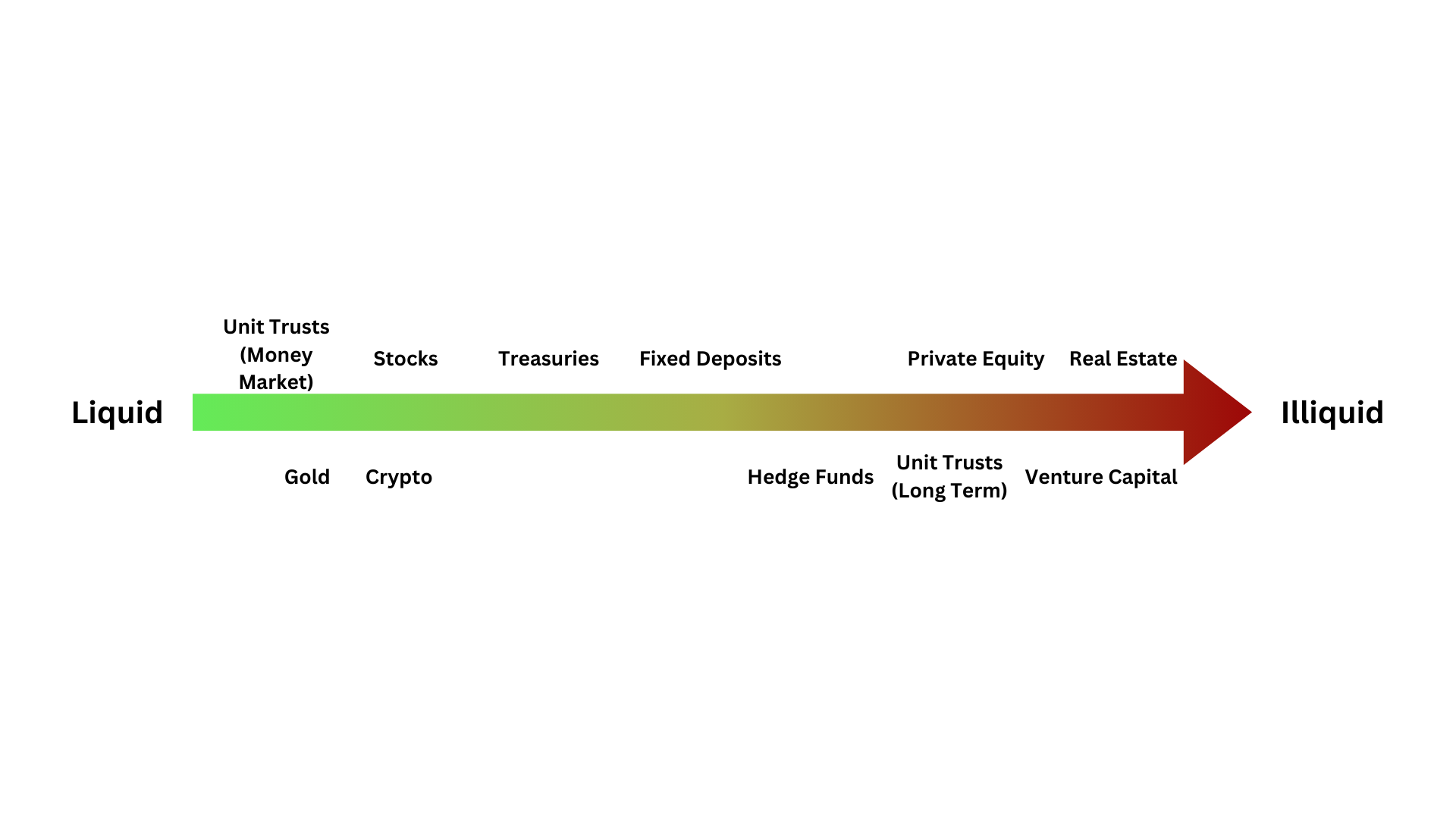
Liquidity refers to how easily you can convert an asset into usable cash. For example, money in your savings account is highly liquid since it can be accessed at any time. Conversely, money tied up in property is considered illiquid, as selling that property involves several steps (notably, loans secured against the property do not affect this classification).
The diagram below illustrates the spectrum of assets from very liquid to illiquid. If your circumstances do not allow for illiquid instruments, consider swapping out some of those assets for more liquid options.
b. Risk
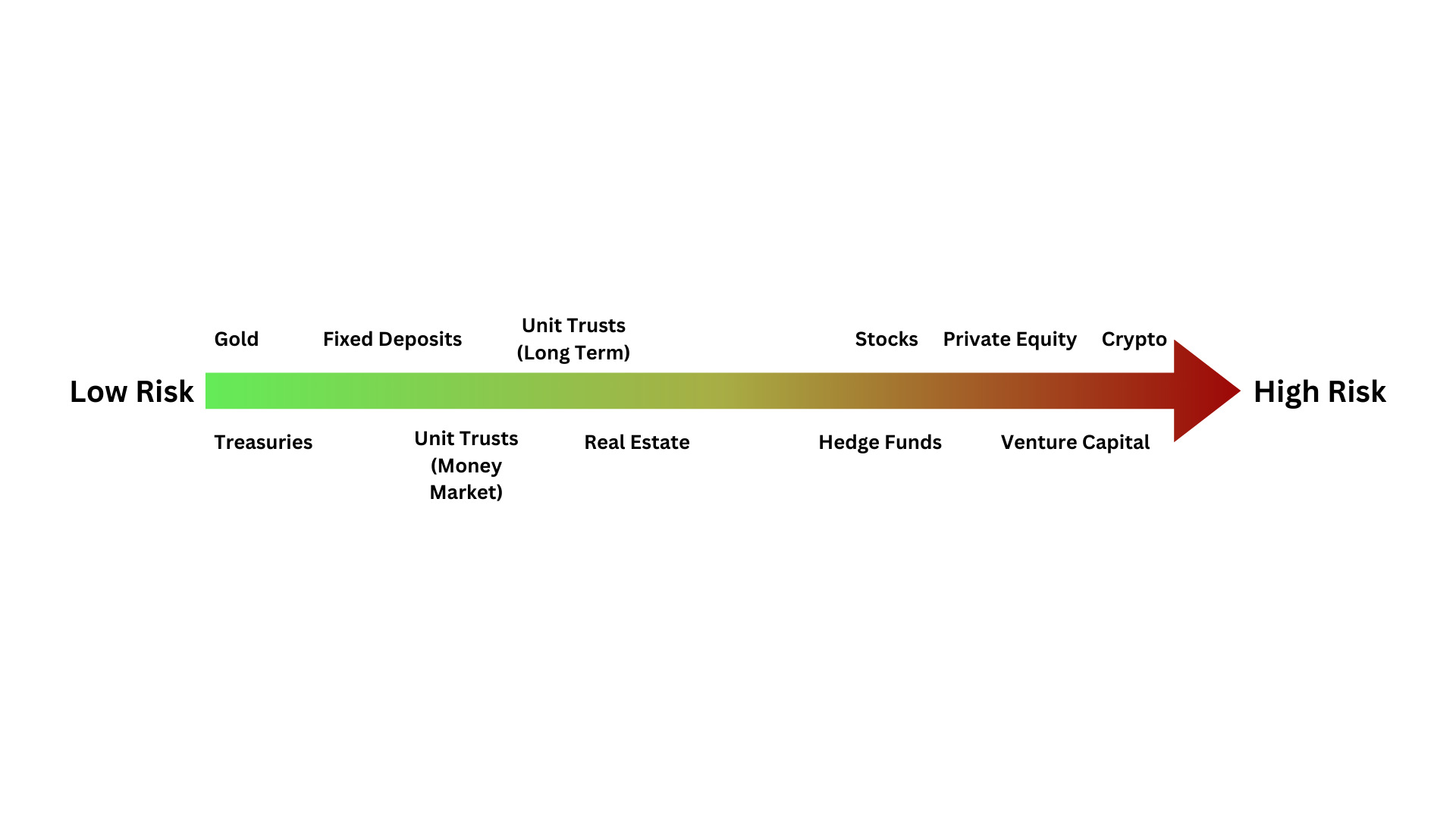
Risk is a natural component of any portfolio. A portfolio devoid of risk is often ineffective. Learning to balance risk is crucial for maximizing your earnings and growing your wealth. As with liquidity, I’ve included a diagram of assets ranging from low risk to high risk below. Feel free to customize your portfolio against risk using this.
c. Fixed Income vs. Growth
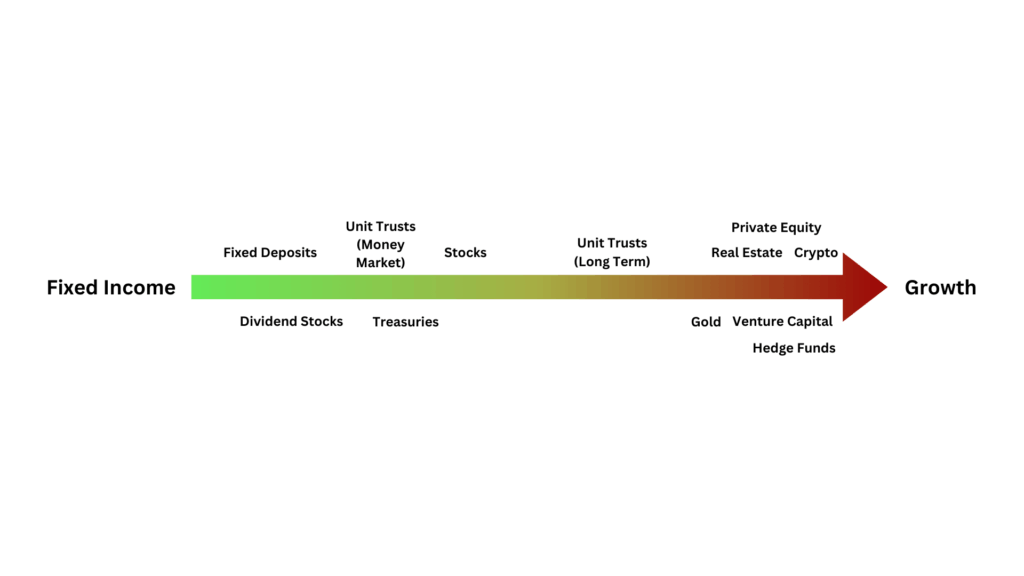
Many households in Sri Lanka tend to focus on increasing their fixed income. While this may be a valid strategy for those nearing retirement or those without a stable monthly income, a growth-oriented portfolio is generally more beneficial for most others, especially if you are young. Again, a diagram showing the spectrum from Fixed Income to Growth is provided below. Follow the guidelines mentioned and adjust your portfolio accordingly.
2. Staying Well-Read and Up to Date on Current Events
Knowledge is power. Luckily for you, knowledge is incredibly accessible in the era of the internet. As an investor, it is absolutely essential that you remain well-read and informed on real-world events. These events have a direct impact on your assets and their performance, whether you like it or not. Depending on the real-world events occurring around you, there will be instances where you would need to modify or alter your portfolio accordingly.
Take, for example, the economic collapse we faced back in 2020,2021, and 2022. As some of you may know, fixed deposit rates were 30% or higher at the peak. To be fair, inflation was also through the roof, but given those circumstances, locking in a significant portion of your capital at 30% for 5 years or higher would be a no-brainer. This is a guaranteed 30% year on year on your investment with minimal risk. Individuals who acted on the opportunity continue to enjoy this to this day.
Another example would be Stocks. Individuals familiar with the stock market may be familiar with the highs experienced in 2019… until it all crashed in 2020. If you understood the economic landscape and either sold in 2019 or bought after the collapse in 2020, your returns would be phenomenal.
Investing is all about making good decisions. And to make good decisions, you need information. This would usually be where I maybe add an affiliate link to some news service, but I got nothing. I personally get all my news from my stockbroker firms. Reading up on digital newspapers also covers quite a bit of ground. So just read – if you have a 30-minute commute to work, read up on all that’s happening in the world – it might just make you a lot of money.
3. Continuous Learning
Investing isn’t a one-time action—it’s a journey. The real rewards come from the compound effect of years of informed, thoughtful decisions. And to keep making those smart choices, you need to keep learning.
One of the best ways to do that? Reading.
Books often distill decades of experience, failures, and successes into a few hundred pages. They give you insights that would otherwise take years to learn firsthand. Personally, it was this love for learning that sparked my interest in investing in the first place.
To support your journey, I’ll be sharing the key lessons I’ve picked up—both from books and experience—on the Learn & Grow page. Hope to see you there!
That wraps up this post series!
I truly hope this gave you a solid starting point as you take your first steps into the world of investing. Since many of you are looking to get into stock trading, I’ll be putting together a practical guide on how to set up all the necessary trading accounts here in Sri Lanka next.
Thanks so much for reading—and here’s to growing, learning, and investing wisely!