
Understanding the Audit Report – Why it’s Important for an Investor
Would you trust a stranger with your money if someone you know and trust says the guy is sketchy and is not in a good financial position to pay you back? That`s where auditors come in. An auditor is like the friend you can trust to vouch for someone`s integrity.
What is the role of an auditor?
An auditor is an independent party that the shareholders of the company appoint to make sure that the management is working to pursue the interests of the shareholders without being compromised. The management has the responsibility of preparing the financial statements, and in the annual report, the external auditor of the company will express their opinion about the accounting practices and the going concern (whether the company has the financial ability to continue into the foreseeable future) of the company. It can be found under the audit report section of the annual report.
Why You Should Read the Audit Report
Referring to the audit report is important because management could potentially manipulate the financial statements. It is the responsibility of the auditor to ensure that the company’s financial reporting complies with the relevant accounting standards in Sri Lanka, namely the Lanka Accounting Standards (LKAS). The auditor must also verify that the statements are free from material misstatements — that is, significant differences between what should be reported and what is actually reported. A misstatement is considered material if it could influence the decision-making of users of the financial statements.
Audit Opinions
In the audit report the key point that a shrewd investor should focus on is the audit opinion; it could sum up the whole report for you. There are two main types of audit opinions- Unmodified Audit Opinion and Modified Audit Opinion.
1.Unmodified Audit Opinion
An unmodified audit opinion would start as;
“Financial statements give a true and fair view”, which means that the financial statements are not materially mis-stated, and the information revealed is objective. Now in the real world, compiling near perfect 100% accurate financial statements is impractical due to human error, assumptions & judgements etc. A certain number of mistakes is acceptable. Thus, this opinion only gives the investors a reasonable guarantee.
2. Modified Audit Opinion
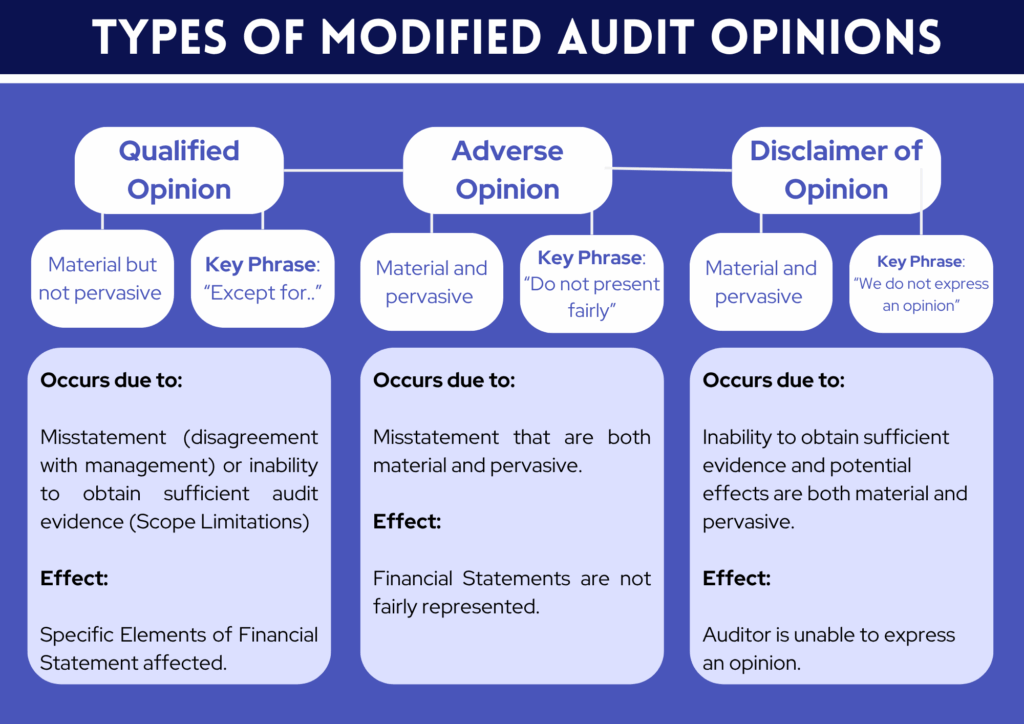
As seen above, the type of modified opinion issued depends on how serious and widespread the issue is. While a Qualified Opinion points to isolated concerns, an Adverse or Disclaimer of Opinion signals deeper problems that could significantly affect users’ trust in the financial statements. Understanding these distinctions is key to interpreting an auditor’s report accurately.
But Are Auditors Always Right?
The auditors are not without their flaws either, some of you may have heard about the Enron Scandal (2001), in which the independent auditor and the advisor to the Energy company Enron (Arthur Anderson Partnership) failed to brought into investor attention the malpractices and widespread accounting fraud that inflated profits and concealed debt.
However, more often than not auditors become successful uncovering concerns ,such as ZTE corporation (2018) for reporting inconsistencies and non-compliance with international law, uncovering the insider trading practices of the Raj Rajarathnam`s hedge fund(USA,2009). To sum it all up financial statements present a narrative crafted by the management ,the audit report could where to look for cracks and holes if there`s any.
Reading between the lines
At the end of the day, financial statements tell a story written by management. The audit report helps you find the cracks in that story, if there are any. As an investor, knowing how to interpret an audit opinion can mean the difference between a smart decision and a costly mistake.
Case Studies for Further Reading
The Enron Scandal and Accounting Fraud
